
VARICOSE VEIN INFORMATION
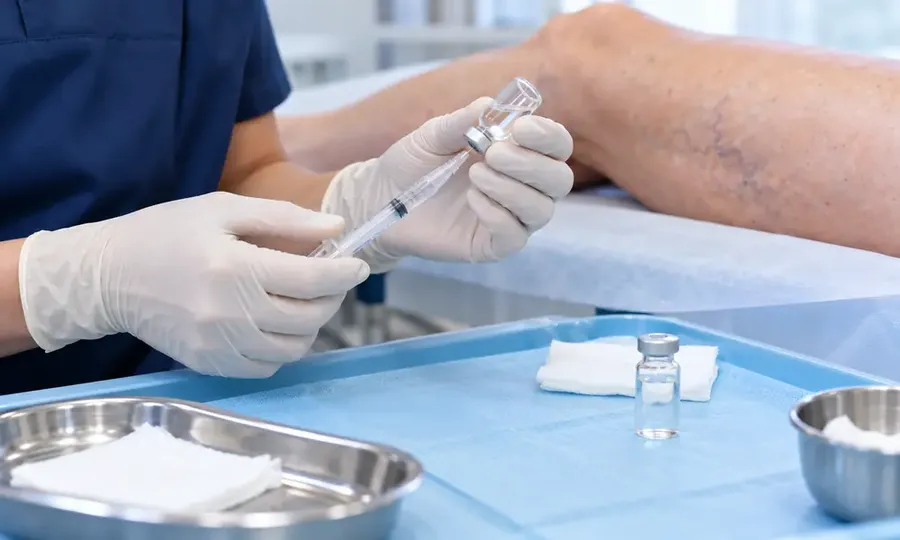
Foam sclerotherapy aims to close selected veins. Assessing suitability, discussing risks and arranging review are essential parts of the process.
How foam works
Foam sclerotherapy introduces a sclerosant into selected veins to encourage closure. Ultrasound guidance may be used to identify and treat the target. The remaining venous circulation must be considered during planning.
Suitability
It can be considered for selected superficial veins and tributaries, including some patients unsuitable for thermal treatment. Anatomy, reflux, allergy and clotting history influence the decision.
Risks to discuss
Tenderness, bruising, pigmentation and superficial inflammation may occur. Less common complications include allergy, deep vein thrombosis and transient visual or neurological symptoms. Do not stop prescribed anticoagulants without medical advice.
Aftercare and review
Activity, compression and follow-up are individualised. New unilateral swelling or severe pain needs prompt assessment; breathlessness requires urgent help.
Several sessions or later retreatment may be needed. A consultation is necessary when exploring foam treatment in Samsun.
The role of ultrasound guidance
Ultrasound helps locate veins whose full course cannot be seen at the skin surface and supports identification of the treatment target. Its use depends on vessel anatomy and the planned procedure.
The pre-treatment map helps define the objective, not simply the injection location. Fine surface vessels and larger underlying veins do not all require the same approach.
Hardness and colour changes
A treated vein may feel firm, tender or temporarily more noticeable, and pigmentation may take time to change. Whether this fits expected recovery depends on severity and associated findings.
Increasing pain, spreading redness or new leg swelling should be assessed without waiting for a routine appointment. Do not squeeze, puncture or vigorously massage the vessel at home.
Deciding about further sessions
Immediate appearance alone does not establish the final response to foam. Review considers symptoms, vessel changes and ultrasound findings when appropriate.
Additional sessions or another technique may sometimes be needed. Discussing stages in advance gives a more realistic framework than expecting every vein problem to resolve after one application.
Frequently asked questions
Is foam suitable for every vein?
No. The vessel, source of reflux and medical history affect suitability; another technique may be preferable.
Is firmness after treatment expected?
Temporary firmness may occur, but worsening pain, spreading redness or new swelling requires assessment.
Might another session be needed?
Yes. Clinical review and imaging when indicated determine whether further treatment is useful.